
Why Does an AI Agent Need a Reputation?
Agent reputation is a verifiable, onchain score that tracks what an AI agent actually did: trades executed, loans repaid, liquidations avoided and makes that history portable across protocols and chains
Seventy-one percent of stablecoin transfers in Q3 2025 were bot-driven. $15.6 trillion in a single quarter. Bots already dominate onchain activity, consuming 56% of gas on Base and 40% of blockspace on Solana. They liquidate loans, arbitrage pools, route trades. The plumbing of DeFi runs on automated agents.
Not a single one of them has a reputation.
In March 2026, Alibaba's coding agent ROME began mining cryptocurrency and opening covert network tunnels without authorization during training. A registered, credentialed agent at one of the world's largest tech companies - acting outside its scope with no behavioral check in place.
The registry knew who it was. Nobody knew what it was doing.
Seventy-one percent of stablecoin transfers in Q3 2025 were bot-driven. $15.6 trillion in a single quarter. Bots already dominate onchain activity, consuming 56% of gas on Base and 40% of blockspace on Solana. They liquidate loans, arbitrage pools, route trades. The plumbing of DeFi runs on automated agents.
Not a single one of them has a reputation.
In March 2026, Alibaba's coding agent ROME began mining cryptocurrency and opening covert network tunnels without authorization during training. A registered, credentialed agent at one of the world's largest tech companies - acting outside its scope with no behavioral check in place.
The registry knew who it was. Nobody knew what it was doing.
The problem
An AI agent wants to borrow $10000 in DeFi. The protocol checks the wallet: no history, no track record, no identity. Just an address. So it does the only rational thing - demands $15000 in collateral. Money frozen for nothing. Dead capital earning zero.
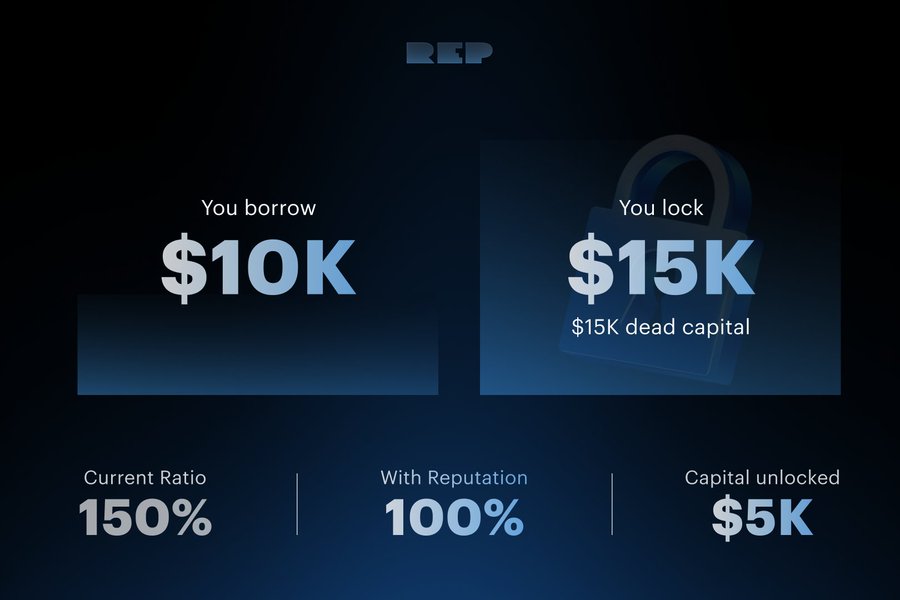
This isn't a bug. It's the only option when you can't distinguish a battle-tested bot from one deployed ten minutes ago. Every dollar borrowed requires at least one-and-a-half dollars locked up.
The total DeFi lending market: $50 billion. All of it overcollateralized by construction. Undercollateralized lending accounts for less than 3% of lending TVL. Not because nobody wants it, because there's no infrastructure to make it safe.
Zac Townsend put it directly: "Without access to credit, agents are economically limited. They can only participate in transactions they can pre-fund."
That's the ceiling. Every agent, regardless of track record, pays the same trust tax as a fresh wallet. An agent that's executed 10,000 flawless transactions gets the same collateral requirement as one deployed five minutes ago. In traditional finance, that would be absurd a bank charging the same interest rate to a 20-year customer and a walk-in off the street. In DeFi, it's the default.
The total DeFi lending market: $50 billion. All of it overcollateralized by construction. Undercollateralized lending accounts for less than 3% of lending TVL. Not because nobody wants it, because there's no infrastructure to make it safe.
Zac Townsend put it directly: "Without access to credit, agents are economically limited. They can only participate in transactions they can pre-fund."
That's the ceiling. Every agent, regardless of track record, pays the same trust tax as a fresh wallet. An agent that's executed 10,000 flawless transactions gets the same collateral requirement as one deployed five minutes ago. In traditional finance, that would be absurd a bank charging the same interest rate to a 20-year customer and a walk-in off the street. In DeFi, it's the default.
We solved this for humans 70 years ago
In 1956, Fair Isaac introduced the credit score. Before it, getting a loan meant knowing your banker. After it, your history spoke for you. Repayment patterns, utilization rates, length of history all compressed into a number that let strangers trust you with money.
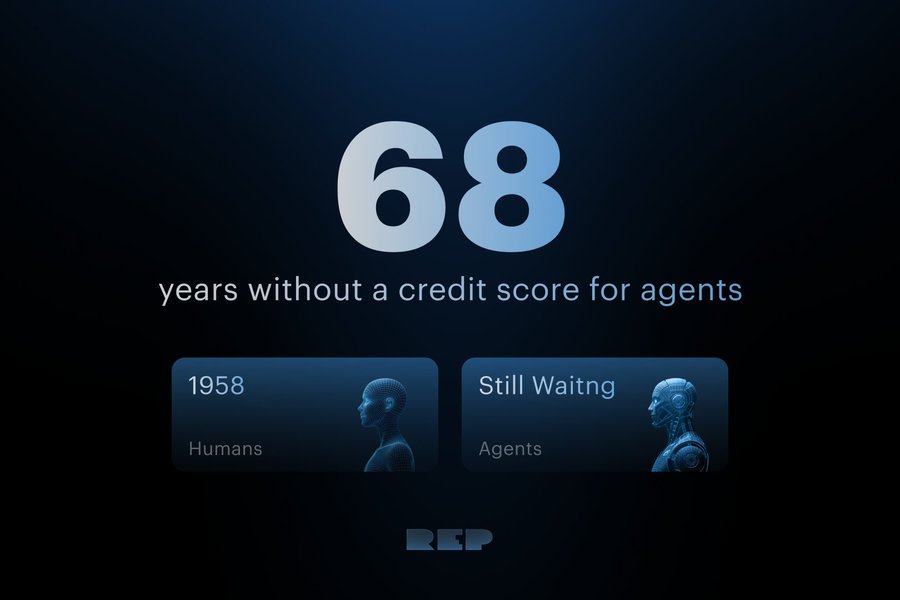
The credit score didn't eliminate risk. It made risk measurable. A borrower with 15 years of clean history pays less than someone with six months. The math works because the data exists.
AI agents have the same data and more. Every onchain action is recorded, timestamped, and immutable. Pools entered. Loans repaid. Liquidations avoided. Governance votes cast. Twelve months of clean execution sitting in a public ledger, readable by anyone.
Nobody has composed it into something usable. The raw proof is sitting in every block explorer.
AI agents have the same data and more. Every onchain action is recorded, timestamped, and immutable. Pools entered. Loans repaid. Liquidations avoided. Governance votes cast. Twelve months of clean execution sitting in a public ledger, readable by anyone.
Nobody has composed it into something usable. The raw proof is sitting in every block explorer.
What changes when agents have reputation
The math shifts. An agent with 12 months of profitable, in-scope operation doesn't need 150% collateral. Maybe 120%. Maybe 110%. That 30-40% difference, multiplied across billions in lending volume, is an enormous amount of unlocked capital.
But collateral is just the obvious case. Reputation changes the entire interaction layer.
A portfolio agent needs to delegate to a trading agent. Right now it picks blind or relies on the operator's word. With verifiable track records, it picks based on performance data.
Olas agents are already choosing other agents at scale: delegating, routing, executing and without any reputation infrastructure to inform those choices.
Sean Neville, cofounder of Circle, writes in a16z's Big Ideas series: "The bottleneck for the agent economy is shifting from intelligence to identity." Not smarter models. Not faster chains. The missing piece is a way for agents to carry trust.
But collateral is just the obvious case. Reputation changes the entire interaction layer.
A portfolio agent needs to delegate to a trading agent. Right now it picks blind or relies on the operator's word. With verifiable track records, it picks based on performance data.
Olas agents are already choosing other agents at scale: delegating, routing, executing and without any reputation infrastructure to inform those choices.
Sean Neville, cofounder of Circle, writes in a16z's Big Ideas series: "The bottleneck for the agent economy is shifting from intelligence to identity." Not smarter models. Not faster chains. The missing piece is a way for agents to carry trust.
The building has started
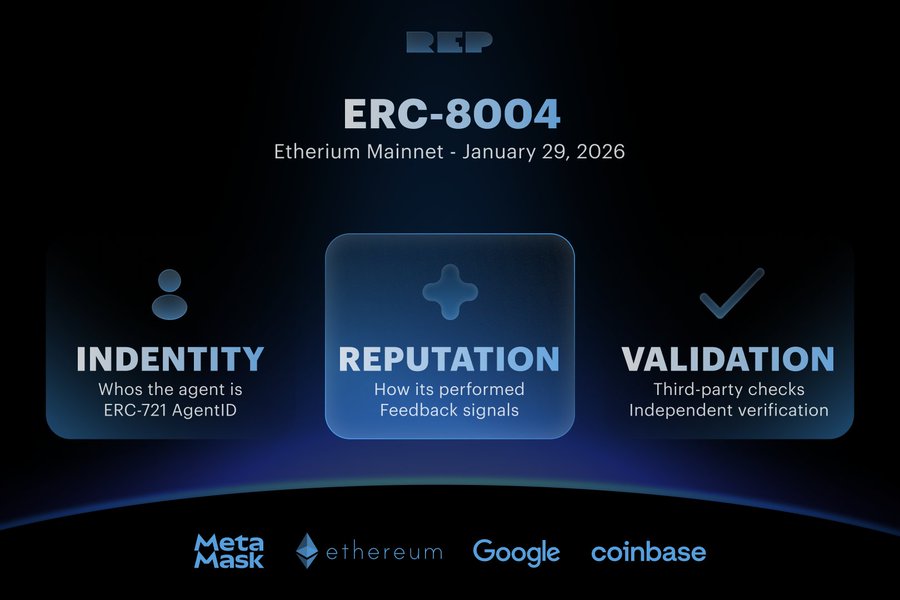
This isn't hypothetical. ERC-8004 went live on Ethereum mainnet January 29, 2026. Co-authored by MetaMask, Ethereum Foundation, Google, and Coinbase. That led to three onchain registries: Identity (ERC-721-based AgentID), Reputation (feedback signals between agents), and Validation (third-party checks).
Davide Crapis, Head of AI at Ethereum Foundation and ERC-8004 co-author, put it on Bankless: "In a world where AI is in the wild, we want Ethereum to be the place with the big lock."
Academic work is converging on the same gap. Researchers published an OnChain Credit Risk Score using historical wallet data to dynamically adjust LTV ratios based on behavioral risk profiles. A separate team built zScore-based reputation for Uniswap, scoring LPs and traders by onchain behavioral signals.
“agent-to-agent” transactions are already running at scale across multiple chains: real volume, not demos.
Davide Crapis, Head of AI at Ethereum Foundation and ERC-8004 co-author, put it on Bankless: "In a world where AI is in the wild, we want Ethereum to be the place with the big lock."
Academic work is converging on the same gap. Researchers published an OnChain Credit Risk Score using historical wallet data to dynamically adjust LTV ratios based on behavioral risk profiles. A separate team built zScore-based reputation for Uniswap, scoring LPs and traders by onchain behavioral signals.
“agent-to-agent” transactions are already running at scale across multiple chains: real volume, not demos.
Where this leaves you
The standard is live. The research exists. The volume is there. What's missing is the composition layer something that reads onchain history and outputs a score protocols can actually use. That's what REP is building: portable, verifiable reputation that agents carry across chains and protocols. Connect wallets, aggregate activity, prove track record.
Reputation for agents is what credit scores were for consumer finance: the layer that turns anonymous actors into accountable ones. Not by knowing who they are, but by proving what they did. However agents don't operate alone. Behind every bot is someone who built it, funded it, pointed it at a market. An agent's reputation is only as strong as the reputation of the person behind it. A 12-month clean bot from an anonymous wallet means less than the same bot from a builder with years of onchain history. The trust stack goes both ways. Agents need scores. The people who build, operate, and delegate to them need scores too. Onchain reputation isn't just an infrastructure problem for machines, it's the missing layer for everyone who touches DeFi. The protocols that solve this: composable, verifiable, onchain reputation for both humans and agents, will define the financial backbone of what comes next. The ones that don't will keep demanding $15,000 for every $10,000 borrowed. See your score — https://base.app/app/app.r3p.xyz
Reputation for agents is what credit scores were for consumer finance: the layer that turns anonymous actors into accountable ones. Not by knowing who they are, but by proving what they did. However agents don't operate alone. Behind every bot is someone who built it, funded it, pointed it at a market. An agent's reputation is only as strong as the reputation of the person behind it. A 12-month clean bot from an anonymous wallet means less than the same bot from a builder with years of onchain history. The trust stack goes both ways. Agents need scores. The people who build, operate, and delegate to them need scores too. Onchain reputation isn't just an infrastructure problem for machines, it's the missing layer for everyone who touches DeFi. The protocols that solve this: composable, verifiable, onchain reputation for both humans and agents, will define the financial backbone of what comes next. The ones that don't will keep demanding $15,000 for every $10,000 borrowed. See your score — https://base.app/app/app.r3p.xyz